 OTA Strategy
How OTAs Actually Rank Your Listing (And What You Can Do About It)
Airbnb, Booking.com, MakeMyTrip and Goibibo don't rank listings randomly. Here's the funnel they measure, and the five things holiday home hosts can control.
Key takeaways
- OTAs — Airbnb, Booking.com, MakeMyTrip, Goibibo — rank listings by expected conversion, because commission on a confirmed booking is their only revenue.
- The funnel they measure is impressions → click-through → time on page → enquiries → conversion. A weak cover photo kills clicks; a six-hour reply kills conversion.
- Never use your property's brand name as the OTA listing name. "Cozy 2BHK Villa with Private Pool" outperforms "Casa Verde", and a searchable brand name leaks guests to your direct channel — which the platform reads as poor conversion and deprioritises.
- Keep Instant Book on, screened with guest requirements (verified ID, review history) and backed by real-time accurate availability. Promotions accelerate a listing that already works; they cannot rescue a broken funnel.
- Run two channels with two jobs: descriptive OTA listings for discovery, and your own website, Google Business Profile and Instagram for direct bookings. Doorloom is the India-built PMS for holiday homes that covers the enquiry stage most systems skip, plus a channel manager and a free branded booking site.
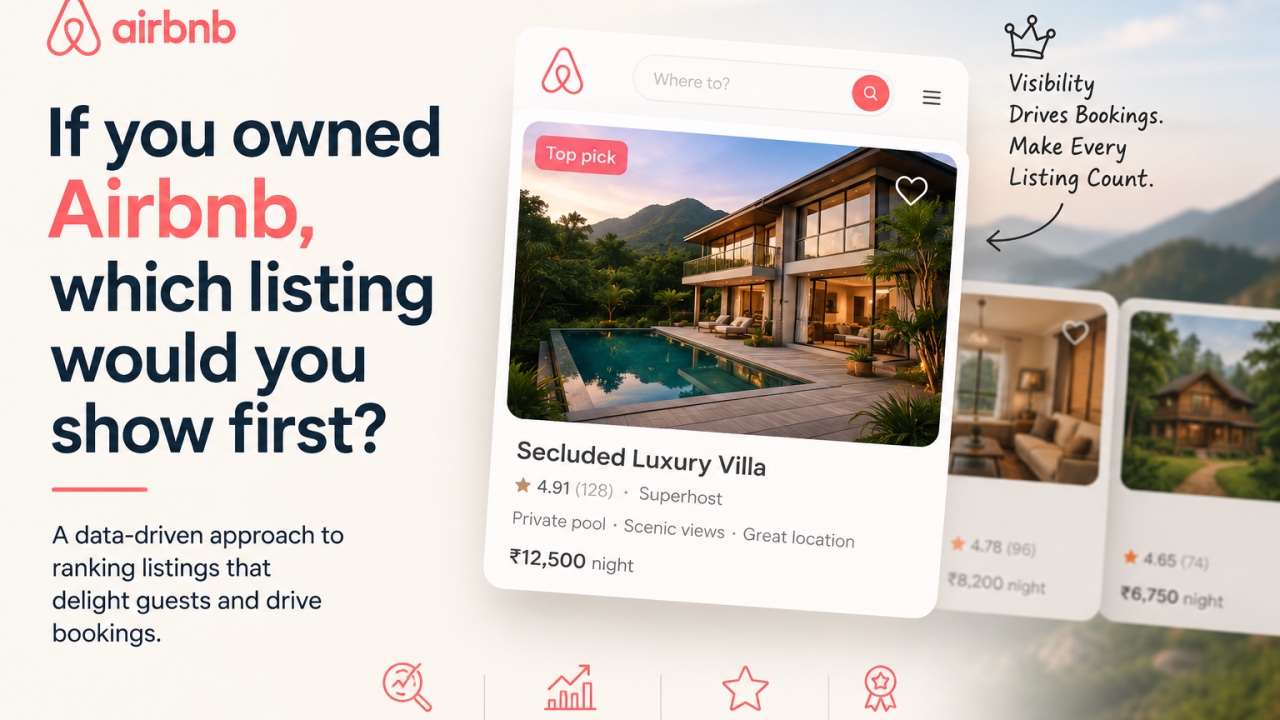
Most hosts think about OTA rankings backwards. They ask "what do I need to do to rank higher on Airbnb?" when the more useful question is "if I owned Airbnb, which listing would I show first?"
Answer that honestly and the whole thing becomes obvious.
Start with how an OTA makes money
An online travel platform like Airbnb, MakeMyTrip, Agoda or Booking.com spends heavily on advertising. Search ads, display, retargeting, brand campaigns — all of it aimed at being there at the exact moment someone starts looking for a villa or homestay.
The platform earns nothing for that traveller's visit. It earns only when a booking is confirmed, because its revenue is a commission on that booking.
So the platform has one job at the moment of search: put the property in front of the guest that is most likely to convert. Not the newest listing. Not the prettiest one. The one that has historically turned attention into confirmed revenue.
Every ranking rule you've ever heard about is downstream of that single incentive.
Your listing is an ad campaign, whether you treat it like one or not
If you've ever run a performance campaign, you already know the funnel:
Impressions → Clicks → Engagement → Leads → Conversions
An OTA listing works exactly the same way, and the platform is measuring every step of it for your property.
1. Impressions and reach — how often you're shown
This is the platform's investment in you. It's showing your property in search results for a location and a set of dates. Every impression is an opportunity the platform has spent money to create.
New listings usually get a burst of impressions. This is the platform testing you. What you do with that test decides everything that follows.
2. Click-through rate — do people open your listing?
Out of everyone who saw your property in results, how many clicked in?
At this stage the guest has seen almost nothing: your hero image, your title, your price, your rating. That's it.
So if your click-through rate is poor, your hero image is the problem. Not your amenities, not your description — nobody has read them yet. A dark, cluttered, badly composed cover photo will quietly kill a listing that is otherwise excellent.
3. Time on page — does your content hold them?
Once a guest opens your listing, the platform watches how long they stay and how deep they go.
If they bounce in a few seconds, your property page didn't deliver on what the cover photo promised. Thin photo set, confusing layout, missing details on the pool, the bedrooms, the drive time, the house rules. Guests leave when they have to work to understand what they're buying.
If they scroll, expand the photos and read the reviews, your content is doing its job.
4. Enquiries and booking requests — the real click-through
This is where a browser becomes a lead. They message you, request to book, or open the calendar seriously.
Getting here means your visuals and content worked. What happens next is entirely in your hands.
5. Conversion — the number that decides your ranking
Of all the guests who reached out, how many actually booked?
This is the metric the platform cares about most, because it is the only one that pays them. A high enquiry volume with a low booking rate is, from the platform's point of view, a waste of the advertising money it spent to send you those guests.
A weak conversion ratio almost always comes down to one of four things:
- Price — you're above the market for comparable properties on those dates
- Reviews — recent negative reviews, or too few reviews to build trust
- Response speed — you replied in six hours, a competitor replied in six minutes
- Response quality — short, transactional replies that don't answer what the guest actually asked
Fix these and your ranking improves without you touching anything else. The platform is simply following the money.
The listing name mistake almost every host makes
Here is the one that costs hosts the most and gets discussed the least.
Do not use your property's brand name as your listing name.
Not "Casa Verde." Not "Windmere Estate." Not "The Nilaya."
A listing name that combines a hook with the property type will outperform it every time:
- Sleek Sky Loft
- Cozy 2BHK Villa with Private Pool
- Minimalist Urban Studio
- Hillview Farmstay for Families, 4BHK
There are two reasons, and the second one is the one hosts don't see coming.
The obvious reason: a descriptive name sells
Your listing name is doing work in a crowded search result. "Windmere Estate" tells a guest scrolling on a phone absolutely nothing. "Cozy 2BHK Villa with Private Pool" tells them what it is, who it's for, and why they should stop scrolling. Better clicks, better funnel, better ranking.
The reason nobody mentions: the platform is watching for it
Platforms are smart enough to recognise when your listing name is your actual, searchable brand name.
Think about what that name enables. A guest finds you on the OTA, likes what they see, opens a new tab, searches your property name, finds your website or your Google listing, and books you directly. The platform spent money to put you in front of that guest and earned nothing for it.
Now look at what the platform's data shows: strong impressions, decent clicks, good time on your page — and then the guest disappears without an enquiry or a booking. From the platform's side, that's just a poor conversion ratio. The listing gets deprioritised, impressions fall, and the discovery you were relying on quietly dries up.
So the branded listing name may win you a handful of direct bookings this month, and it will cost you visibility next month. That trade doesn't hold up over a season.
The advice
Keep your OTA listings descriptive and let the platform earn the commission it worked for. That relationship is worth protecting — the OTA is doing real, expensive work to find guests you couldn't reach on your own.
Build your direct bookings the other way: your own website, your Google Business Profile, your Instagram, your repeat guests, your local network. That channel is yours to grow, and it grows without putting your OTA ranking at risk.
Two channels, two jobs. Don't make one cannibalise the other.
Keep Instant Book switched on
Same principle, different lever.
Think about what happens when a guest lands on a listing without instant booking. They've been advertised to, they've searched, they've scrolled, they've opened your page, they've decided they want it — and then they hit a wall. Request sent. Now wait.
Every hour in that gap is a chance to lose them. They keep browsing. They find something comparable that books in one tap. Their plans shift, their group changes its mind, someone else in the group finds a place on a different app. The booking cycle stretches, and a stretched booking cycle converts worse. Always.
Now think like the platform. It spent money to bring that guest all the way to the point of purchase. Why would it send the next guest to a property that adds a delay and a maybe, when it can send them to one that closes on the spot?
It wouldn't. Platforms want the guest journey short and smooth, and listings that require approval are quietly working against that goal. The result shows up as fewer impressions, and most hosts never connect the two.
The objection is fair, and it's solvable. Most hosts who keep Instant Book off are worried about who walks through the door — and for a villa or farmstay in Goa or Lonavala, that's a real concern, not paranoia. But the answer is to use the platform's guest requirements: verified ID, minimum review history, no bookings from guests without a track record. Set clear house rules, take a security deposit, and screen through the tools rather than by holding up every booking.
One condition before you turn it on: your availability has to be genuinely accurate across every channel, in real time. Instant booking on stale inventory is how you end up cancelling on a guest — which costs you far more, in penalties and in reviews, than the friction ever did.
Do promotions and discounts help?
Partly, and usually not the way hosts hope.
A 20% promotion can buy you a temporary lift in visibility. Platforms like promoting discounted inventory because discounts convert. What a promotion cannot do is repair a broken funnel.
If your cover photo doesn't earn clicks, if your page doesn't hold attention, if you take hours to reply — the discount just means you're now losing the same bookings at a lower rate. The extra reach fades, the conversion data stays bad, and you slide back down the results, poorer for it.
Use promotions to accelerate a listing that already works. Don't use them to rescue one that doesn't.
The two habits that separate ranked listings from forgotten ones
Refresh your listing
"Refreshing" doesn't mean logging in. It means genuinely updating what a guest sees.
If your photographs are the same ones you uploaded last season, if your description still lists an amenity you removed, if you've added a plunge pool or a new deck and never showed it — your listing is stale, and platforms deprioritise stale inventory.
Reshoot after any meaningful change. Rotate your hero image seasonally, especially where a monsoon-season photograph sells a completely different stay from a winter one. Keep the title and description honest and current.
Adjust your pricing to demand
This is the single most under-used lever available to holiday home hosts in India.
Weekday and weekend demand for a Goa villa or a Lonavala farmstay are not remotely the same market. Long weekends, festival dates, school holidays, wedding season and monsoon lulls all move the price a property should command — sometimes week to week.
A flat rate across the calendar means you are simultaneously overpriced on slow dates (killing conversion) and underpriced on peak dates (leaving money behind). Both hurt. Only one of them is visible in your bank account.
Hosts who revise pricing frequently attract higher-intent guests and convert more of them, which is exactly the behaviour that pushes a listing up the results.
Use a PMS. Then pick the right one.
Most of what's above is craft: better photographs, better writing, sharper listing names, faster replies. Nobody can automate taste.
What software removes is the operational drag — and the drag is what quietly stops hosts from doing any of it consistently. Pricing that should change weekly doesn't change for months, because it means logging into four extranets. Instant Book stays off, because availability lives in a spreadsheet nobody trusts. Enquiries go cold in a WhatsApp thread that scrolled away.
So the first decision is simply to run your property on a property management system rather than on memory and message threads. Any reasonable PMS will give you a channel manager and booking management, and that alone will lift your ranking, because it makes daily pricing and accurate availability practical instead of aspirational.
The second decision is which one — and that depends on how you actually take bookings.
India already has capable PMS and channel managers that have served Indian properties for years, and they handle OTA distribution well. But most of them are built around hotels, and none of them do much for the part of your business that isn't a confirmed booking yet: your direct enquiries.
If you run purely on OTAs, that may not matter to you. But if you take both direct and OTA bookings, which nearly every villa, homestay and farmstay in India does, it matters a great deal. That's what Doorloom is for.
What is Doorloom?
Doorloom is an application built specifically for holiday homes, combining Enquiry Management, Booking Management, a Channel Manager and a Property Management System (PMS) in one place — for villas, homestays, farmstays and boutique resorts across India.
A real enquiry management system for your direct business. Most PMS platforms pick up only after a booking is confirmed — dates set, money attached. Very few handle the stage before it: the enquiry. That stage lives in a long, time-consuming chat, and it's exactly where direct bookings are won and lost. Doorloom turns it into a pipeline you can reply from in seconds, professionally — and close a booking while you're at dinner with your family.
It works with the same WhatsApp Business number you already use. No new number, no asking guests to change how they talk to you. Your enquiries stay where your guests already are.
Channel manager and booking management. The channel manager is the same core every other PMS offers — connected to your OTAs so prices and inventory update across platforms. The booking management isn't the same, and neither is the booking engine. On an OTA, a guest will book a villa instantly. On your own site, most won't — they want to talk to you first, ask about the pool, the drive, the group size. So the booking engine is built for how holiday homes actually sell, with direct UPI payment for guests who are ready, and a payment gateway for anyone who'd rather pay by card.
A branded website at no extra cost. A website with a built-in booking engine, and you can connect your own domain to it. No development cost, no server, no hosting charges. Put it on your Google Business Profile, in your Instagram bio, and anywhere else your guests find you.
Built for holiday homes, not hotels. This is the difference you'll feel on day one. Most PMS software is hotel software with a villa label on it — room blocks, front-desk workflows, night audits, a hundred fields you'll never use. Doorloom is designed around how a villa or farmstay actually runs, so it stays clean and minimal while still carrying the small details holiday home operators genuinely need and hotel software has no concept of.
That's the balance worth building: descriptive listings and a smooth booking journey that keep you visible on the OTAs, and a direct channel of your own that you grow organically alongside them. Rank where the guests are looking. Own the relationship afterwards.
Happy hosting.
FAQ
Questions hosts ask about OTA rankings
How does Airbnb decide which listings to show first?
By expected conversion. An OTA earns a commission only when a booking is confirmed, so at the moment of search it puts forward the property most likely to turn that attention into confirmed revenue — not the newest listing, and not the prettiest one. Every ranking rule you have heard about is downstream of that single incentive.
Why is my Airbnb listing suddenly getting fewer views?
Falling impressions almost always follow falling conversion. The platform watches the whole funnel — impressions, click-through, time on page, enquiries, bookings — and pulls back on listings where guests arrive but do not book. The usual causes are price above the market for comparable properties on those dates, recent negative or too few reviews, slow replies, and short transactional responses that do not answer what the guest asked. Stale content — old photos, an amenity you removed — gets deprioritised too.
Should I use my property's brand name as my Airbnb or Booking.com listing name?
No. A descriptive name that combines a hook with the property type — "Cozy 2BHK Villa with Private Pool" — outperforms "Casa Verde" every time, because it tells a guest scrolling on a phone what it is and who it is for. There is a second cost too: a searchable brand name lets a guest find you on the OTA and then book you directly, so the platform sees strong impressions and good time on page followed by no booking. That reads as poor conversion, and the listing gets deprioritised.
Does turning on Instant Book improve your OTA ranking?
Yes, because platforms want the guest journey short and smooth. A request-to-book wall gives the guest time to keep browsing and find something comparable that books in one tap, and a stretched booking cycle converts worse. If you are worried about who walks through the door, use the platform's guest requirements — verified ID, minimum review history, no bookings from guests without a track record — set clear house rules and take a security deposit. One condition: your availability has to be genuinely accurate across every channel in real time, or you end up cancelling on a guest.
Do Airbnb promotions and discounts actually help?
Partly, and usually not the way hosts hope. A 20% promotion can buy a temporary lift in visibility because platforms like promoting discounted inventory. What it cannot do is repair a broken funnel — if your cover photo does not earn clicks or you take hours to reply, the discount just means you are losing the same bookings at a lower rate. Use promotions to accelerate a listing that already works, not to rescue one that does not.
How often should a villa or farmstay host change pricing?
Weekly at minimum, and ahead of every long weekend and festival window. Weekday and weekend demand for a Goa villa or a Lonavala farmstay are not the same market, and long weekends, festival dates, school holidays, wedding season and monsoon lulls all move the price a property should command. A flat rate leaves you overpriced on slow dates and underpriced on peak dates at the same time.
Do I need a PMS to rank better on OTAs?
A PMS does not write better photographs or sharper listing names, but it removes the operational drag that stops hosts doing those things consistently — pricing that should change weekly does not change for months when it means logging into four extranets, and Instant Book stays off when availability lives in a spreadsheet nobody trusts. Any reasonable PMS gives you a channel manager and booking management, which makes daily pricing and accurate availability practical. Which one to pick depends on how you take bookings: if you run both direct and OTA, as nearly every Indian villa and farmstay does, you also need enquiry management — the stage before a confirmed booking, which most platforms skip entirely.
Let's talk
Rank where guests look. Own the relationship after.
Call or WhatsApp us — we will show you what your direct channel is worth alongside your OTA listings.